- (+62)21-2002-2012
- Mon - Fri : 09.00-17.00

Problem-solving is one of the most important mental skills we have because the decisions we make and the actions we take to solve problems determine the degree of our success and well-being in life.
Numerous international surveys have shown that there is a big demand for people who are competent in solving complex problems in a wide variety of situations.
They consist of a number of interrelated problems, usually with one overarching or main problem and there are typically many obstacles that have to be overcome. They exist in environments that are constantly changing and difficult to predict.
The training integrates a number of well-established concepts, principles and techniques that are explained in the book, Bridging the Gap: Solving Complex, Real-life Problems – Sharpen your problem-solving skills using this integrative approach by Clive Hunter.

...a big demand for people who are competent in solving complex problems.
Our problem-solving course consists of four modules; an introduction, techniques for solving problems and two modules that train participants to solve complex problems according to basic principles and guidelines. There is a general focus on collaboration and joint problem solving during all four modules which are facilitated by Clive Hunter.
The book, “Bridging the Gap: Solving complex, real-life problems – sharpen your problem-solving skills using this integrative approach” which is to be published by Kallisti Publishers, Pennsylvania, USA
While numerous international surveys have shown that there is a big demand for people who are competent in solving complex problems in a wide variety of situations, not much is being done to help people to develop this important skill. So, the aim of this book is to inform people about well-established concepts, principles and techniques that can be integrated to successfully solve complex problems.
After introducing the topic, the book provides a framework for complex problem solving (CPS) then explains the elements of this framework in a down-to-earth, practical way with relevant illustrations and examples. The book also discusses personal factors that influence our problem-solving ability such as attitudes, assumptions and beliefs, biases, prejudices and our flawed perceptions. This is followed by a chapter on a number of problem-solving techniques such as estimating risk, brainstorming, visualization, various types of charts, feedback loops, SWOT analysis, decision trees and mind maps.
Chapter 8 discusses the important topics of collaboration, teamwork and negotiation in relation to problem-solving.
Titles of the chapters in the book:
Used as a guide for CPS training and practical problem solving
Simple problems are self-contained in that they exist in a limited and predictable environment, they do not interact with many other problems and can be solved by applying established solutions, procedures and/or rules. Complex problems consist of a number of problems that interact with each other and their environment, which is constantly changing and unpredictable. Consequently, they usually require unique, innovative solutions.
These are the survey reports used for the book:
National Research Council (2012) Education for Life and Work: Developing Transferable
Knowledge and Skills in the 21st Century
World Economic Forum (2016) The Future of Jobs: Employment, Skills and Workforce Strategy for the Fourth Industrial Revolution
World Economic Forum (2018) Future of jobs report
World Economic Forum (2020) Future of jobs report.
Hewlett Foundation report (2016) 21st-Century Competencies and Their Impact: An Interdisciplinary Literature Review
Bloomberg Job Skills Report (2016)
Pearson Survey report (2017) The Future of Skills: Employment in 2030
UK Department for Education (2018) Employer Skills Survey Report
Brookings Institute survey report (2018) Education system alignment for 21st century skills
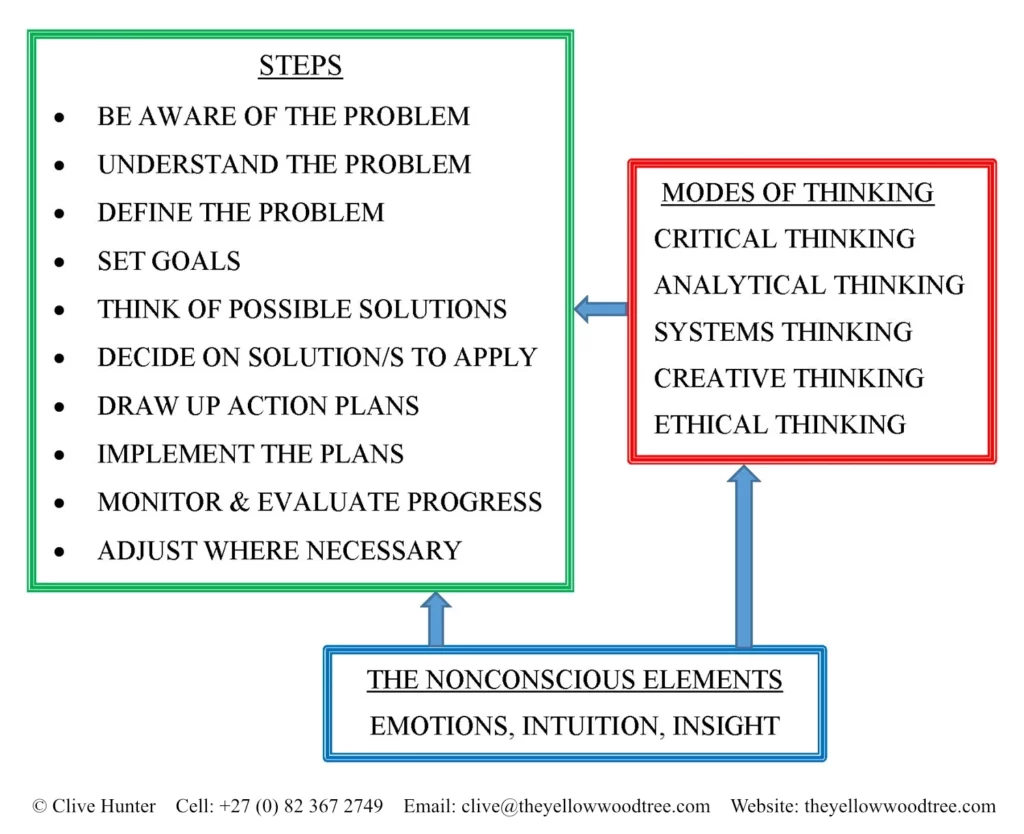
In this case there are a number of aspects of problem solving such as the steps, modes of thinking and nonconscious elements that can be combined or integrated where appropriate to successfully solve problems.
A problem solving framework provides a basic structure, a set of principles, procedures and guidelines for solving problems.
We are able to offer online courses using Zoom. Organisations or groups interested in this approach should contact Clive. Click here for more contact information.